
Use cases
How to generate a pitch deck with AI
Start with the investor argument, not a slide template. Give the model verified customer evidence, traction, economics, and the raise. Then make it show its sources before it produces an editable deck.
Try this exact task
“Here’s our company brief and traction. Make me an investor deck.”
The staged prompt tells OpenCraft to ask for missing facts, expose unsupported claims, and request editable files. You can inspect and change it before anything runs.
- Company brief
- Customer evidence
- Traction and financials
- Editable PPTX
- Review PDF
- Claim and source ledger
Use the complete prompt
Create an investor pitch deck for my company. Ask me for the company brief, customer problem, solution, traction, market evidence, business model, team, financial assumptions, fundraising amount, use of funds, and any source files. Build the argument first, mark unsupported claims, then deliver a claim-and-source ledger, an editable PPTX, and a PDF for review.
Generate the argument before the slides
The deck is a compressed business case
An AI pitch deck generator can produce twenty polished slides from a sentence. That is usually the wrong first move. A pitch deck has one job. It should make a specific reader understand the opportunity, believe the evidence, and take the next meeting.
Write the case in plain text first. State the company in one sentence, name the customer's painful problem, explain your advantage, and show what changed to make the business possible now. If those points do not survive a one-page memo, visual polish will only hide the gap.
“define your company in a single declarative sentence”
Sequoia Capital
AI helps with synthesis, not truth
Use AI to compare interview notes, compress product detail, propose a sequence, and find contradictions. Do not let it invent traction, customer quotes, market size, or financial results. NIST's 2024 generative AI profile treats confident false content as an expected system risk, not a rare edge case.
The common failure is not an ugly slide. It is a polished claim with no owner. Put the source, period, unit, and status beside every number before you ask for visual design. A blank market slide is easier to fix than a credible-looking market number nobody can reproduce.
Build a source brief first
Use this six-step workflow
- Fill the brief with facts, assumptions, and open questions.
- Ask for a one-page investor argument before any slides.
- Approve a claim ledger with a source for every number.
- Choose ten to twelve claims and put one on each slide.
- Generate the editable PPTX and render its review PDF.
- Correct the story, numbers, and layout before sending.
Give the generator evidence
Put the raw material in one packet. Include the product description, customer interviews, traction export, pricing, market sources, financial model, team bios, round target, and use of funds. Tell the generator which facts are approved and which figures remain drafts.
Worked brief: Tillstack, a fictional company
Tillstack sells inventory planning software to specialty retailers with 5–50 locations. The fictional brief contains 42 paying locations, $18,000 MRR, 7% monthly growth for six months, 82% gross margin, a $2 million raise, and a bottom-up market calculation. It explicitly labels every person and company fact as fictional.
This is a useful test because the generator has enough numbers to build a case but no permission to invent customer quotes, market reports, or competitive advantages. Replace it with your verified facts using the template above.
If you need to research and produce several business artifacts from the same context, start with the broader AI assistant for small business workflow.
Separate facts from assumptions
Ask the generator to return a claim ledger before it lays out slides. For every number, list its source, date, unit, and calculation. Mark founder estimates as estimates. Mark planned features as planned. Put unsupported claims into an open-questions list rather than the deck.
| Claim type | Evidence required | Deck treatment |
|---|---|---|
| Revenue and growth | Export plus reproducible calculation | Period and unit on the chart |
| Customer pain | Interview notes or measured behavior | Short quote with context |
| Market size | Named source or bottom-up model | Method and date in a footnote |
| Forecast | Explicit assumptions | Label as projection |
Inspect a real OpenCraft slide run, including the mistake
What the run actually did
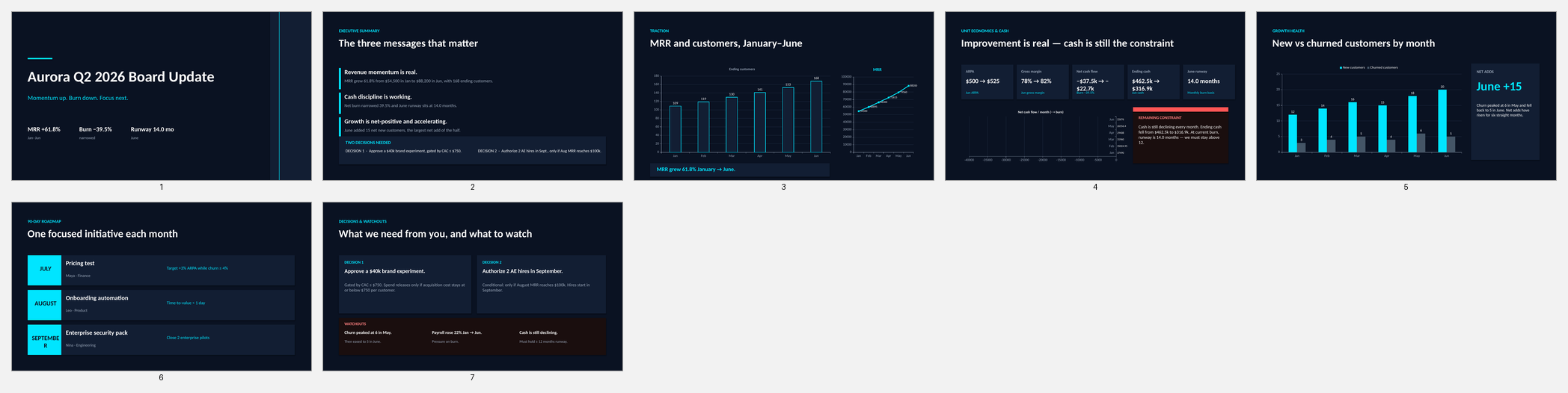
On August 24, 2026, OpenCraft received a fixed fictional dataset for Aurora and instructions for a seven-slide board update. Web research was disabled. The prompt specified the story, visual direction, charts, decisions, and speaker notes. The final receipt showed DeepSeek V4 Flash Vision Exp, 104,000 tokens, and a $0.01 charge.
This is not an investor pitch deck and we do not present it as one. It is evidence for the same editable-PowerPoint pipeline used by the workflow on this page. Download the exact final artifact or the PDF we rendered from it:
Download the actual PPTX Download the rendered PDF Download the exact prompt and data
What failed and what still needs correction
The first sandbox attempt failed because the output directory did not exist. OpenCraft retried. Its visual review then caught a chart-scale error: customer counts and MRR shared one axis, making the customer series unreadable. It split them into separate charts and regenerated the deck.
Use a structure investors can scan
Build ten to twelve core slides
Start with company purpose, problem, solution, why now, market, product, traction, business model, competition, team, financials, and the ask. You may combine sections when the evidence supports it. Put technical depth, customer detail, cohort tables, and financial assumptions in an appendix.
Sequoia's pitch guidance covers the same fundamentals but does not prescribe a rigid visual template. That is useful. Your strongest proof should control the order. A pre-revenue technical company may need product evidence early. A growing marketplace should lead with liquidity or retention.
Make one claim per slide
Use a sentence as the title, not a category label. “Retention reached 91% after the onboarding change” tells the reader what matters. “Traction” does not. Put the evidence directly beneath the claim and remove anything that does not help prove it.
DocSend's pre-seed research found an average deck viewing time of 3 minutes and 40 seconds. Treat that as a design constraint. A reader should understand the argument from slide titles, charts, and a small amount of supporting text.
“they don’t have time to read lots of text.”
DocSend pitch-deck research
Demand editable PPTX and reviewable PDF
PPTX is the working file
A deck is not finished when the generator shows a web preview. You will change numbers, tighten language, replace images, add appendix slides, and adapt the ask for different meetings. Require an editable PowerPoint file with real text boxes, shapes, images, tables, and charts where possible.
OpenCraft builds presentation artifacts from the same conversation that holds your sources and revisions. You can switch models while keeping that context. Check the AI model directory before choosing a model for long documents, images, or difficult reasoning.
PDF is the inspection copy
Export a PDF from the final PPTX and inspect every page. The PDF shows what a recipient will see even if they do not have your fonts or presentation software. Check clipped text, missing glyphs, overlaps, distorted images, inconsistent margins, unreadable footnotes, and charts that lost labels.
In OpenCraft, the deck preview follows the PowerPoint artifact. The PDF is rendered from the file you download. That keeps the preview and deliverable tied to one implementation instead of two unrelated layouts. You can try the workflow from the OpenCraft workspace without claiming that a complete deck will always fit within an initial credit.
Review the deck and know the limits
Read it like a skeptical investor
Check every claim against its source. Recalculate chart values. Ask whether the competition slide names real alternatives, including the customer's current manual process. Remove adjectives that evidence does not support. Then ask someone outside the company to explain the business after a three-minute read.
- Can the reader state the company purpose in one sentence?
- Does every number have a source, period, unit, and owner?
- Does the deck distinguish actual results from projections?
- Does each slide title make a claim?
- Are the PPTX and PDF both readable at laptop size?
- Is the ask specific about amount, milestones, and use of funds?
Use a specialist tool when it fits better
A specialist slide product may be the better choice when you need a large template marketplace, real-time multi-user editing, automatic enforcement of a mature brand system, complex presenter animations, or viewer analytics. OpenCraft is a stronger fit when the hard part is source-heavy reasoning, comparing models, producing related business artifacts, and delivering an editable deck from one working thread.
You can compare that workspace model with Claude's approach in our Claude Cowork alternative article, or browse all OpenCraft use cases. Choose the tool around the bottleneck you actually have.
Sources
- Writing a Business Plan Sequoia Capital
- How to Create an Investor Strategy for Your Pre-Seed Fundraise DocSend
- Generative Artificial Intelligence Profile National Institute of Standards and Technology
Frequently asked questions
Can AI create a pitch deck?
Yes. AI can organize source material, draft the narrative, create charts, lay out slides, and export a presentation. You still need to verify the market, traction, financials, customer claims, and fundraising terms.
What is the best AI pitch deck generator?
Choose based on the job. Use a specialist slide tool when you need a large template library, live team editing, or strict brand automation. Use an artifact workspace when the hard part is researching the case, testing the argument across models, and delivering editable files from the same source thread.
How many slides should a pitch deck have?
Ten to twelve core slides is a useful constraint, not a law. Cover purpose, problem, solution, why now, market, product, traction, business model, competition, team, financials, and the ask. Put supporting detail in an appendix.
What should an investor pitch deck include?
Include a clear company purpose, customer problem, differentiated solution, market, evidence of demand, business model, competition, team, financial plan, use of funds, and specific ask. The exact order should follow your strongest evidence.
Should a pitch deck be PowerPoint or PDF?
Keep an editable PPTX as the working source and export a PDF for stable review and sending. Inspect both. Font substitution, chart rendering, and clipped text can appear only after export.
Can an AI pitch deck generator invent market data?
It can generate plausible but false numbers and citations. Supply the market sources yourself, require a link for each external claim, label estimates, and remove any figure you cannot reproduce.