
Use cases
How to create a business plan with AI
AI can structure a business plan, but it cannot supply the business. Start with a specific reader, verified demand, operating constraints, and financial assumptions you can defend.
Try this exact task
“Here are my restaurant assumptions. Build the lender-ready business plan.”
The staged prompt tells OpenCraft to separate facts from assumptions, ask before filling gaps, and request editable planning files. Review it before sending.
- Offer and customer
- Costs and pricing
- Funding goal and evidence
- Editable DOCX
- Financial model
- Submission PDF
Use the complete prompt
Create a business plan for my company. Ask me for the customer, problem, offer, pricing, sales evidence, competitors, marketing channels, operating process, startup and monthly costs, forecast assumptions, funding need, intended reader, and source files. Separate facts from assumptions, build the financial projections, and deliver an editable document, an editable financial model, and a PDF.
A business plan generator removes the blank page
Let AI structure the work
A business plan has predictable parts. You need an executive summary, company description, market analysis, organization, offer, sales plan, funding request, financial projections, and supporting material. AI can turn notes and research into that structure, keep terminology consistent, and produce a readable first draft.
The useful output is not “complete.” It is inspectable. A reader should be able to change one assumption—sales volume, price, payroll, payment timing—and see the cash forecast change without rewriting the plan by hand.
Do not let it invent the business
A model will often complete missing fields with plausible text. That is dangerous here. A fictional competitor, permit, price, or cost can make the financial section look coherent while breaking the actual plan. NIST's 2024 generative AI profile calls this risk confabulation. Require the generator to mark unknowns and stop before it guesses.
“Confabulations also include generated outputs that diverge from the source input.”
NIST, Generative AI Profile
Choose the plan format and reader first
Use this six-step workflow
- Name the reader and the decision the plan must support.
- Fill the input sheet with evidence, assumptions, and unknowns.
- Choose a lean or traditional structure.
- Build the financial model before writing the executive summary.
- Test base, slower-sales, and higher-cost cases.
- Review the editable files with the appropriate professional.
Use a lean plan to test the idea
A lean plan works when you need to make the idea concrete, identify its weakest assumption, and decide what to test next. Keep it to the customer, problem, offer, channels, key activities, partners, costs, and revenue. The SBA says a lean startup plan can be one page and may take as little as an hour to create.
Use a traditional plan for external review
A lender, grant program, landlord, or investor may need a detailed plan and attachments. Ask the recipient for its requirements before you generate anything. The SBA describes nine common traditional sections, but it also says you should use the sections that fit your business and purpose.
| Reader | Main question | Evidence to lead with |
|---|---|---|
| You and your team | What should we test next? | Assumptions, milestones, cash needs |
| Lender | How will this business repay? | Cash flow, collateral, owner contribution |
| Investor | Can this become valuable at scale? | Market, traction, margins, team |
| Grant reviewer | Does this meet the program goals? | Eligibility, impact, budget, delivery plan |
Worked brief: a 60-seat neighborhood restaurant
Intended reader: lender. Request: $350,000 for equipment, leasehold improvements, opening inventory, and working capital. Model inputs: 60 seats, lunch and dinner turns, average check, food-cost percentage, labor schedule, rent, payment timing, debt terms, and twelve months of cash runway.
The first draft often fails by calling its sales forecast “conservative” without showing capacity. The correction is a visible formula: seats × turns × occupancy × average check × operating days. The owner still has to verify every input with local evidence.
Replace polished guesses with market evidence
Define one customer and one costly problem
“Small businesses” is not a customer segment. Name the buyer, user, location, current workaround, buying trigger, and budget. Add direct evidence such as interviews, paid pilots, waitlist behavior, search demand, or sales from a comparable offer. Separate what customers said from what they paid for.
Research competitors as they operate today
Use current primary sources for prices, features, locations, and policies. Record the access date. Compare direct competitors with the workaround customers use now, including doing nothing. Ask the model to cite every external fact and identify gaps. You can keep web research, competitor notes, drafting, and charts in one OpenCraft thread, then compare models when a task needs a different context window or capability.
Make the financial assumptions explicit
Build from units, prices, and timing
Do not ask AI to “make realistic projections.” State how many leads arrive, how many convert, what each customer pays, when cash arrives, what delivery costs, and when headcount changes. Keep those inputs in an assumptions table. Calculate revenue, gross profit, operating profit, and cash balance from that table.
The SBA tells established businesses to include three to five years of historical statements. For forward projections, it recommends five years of income statements, balance sheets, cash flow statements, and capital expenditure budgets, with monthly or quarterly detail in year one. That is a useful baseline, not a guarantee that every recipient wants the same package.
Run a base case and failure cases
One forecast hides the risk. Build at least three cases. Use a base case, a slower-sales case, and a higher-cost case. Test price, sales cycle, conversion, churn, gross margin, payroll, and payment timing. Show when cash runs out in each case and state which assumptions have direct evidence.
Startup costs need the same treatment. The SBA recommends separating one-time expenses from monthly expenses and counting at least one year of monthly costs. An accountant can help you catch taxes, working capital, depreciation, debt service, and timing issues a prose model will miss.
Inspect an actual OpenCraft financial-model run
The first workbook looked finished. Its formulas were not.
We gave OpenCraft a fixed, fictional six-month SaaS dataset and asked for an editable model with inputs, roll-forward formulas, a board dashboard, charts, and reconciliation checks. The run used DeepSeek V4 Flash Vision Exp, consumed 79,100 tokens, and showed a $0.01 receipt in OpenCraft on August 24, 2026.
The generated workbook was polished enough to pass a quick visual scan. A formula audit found four real defects: January ending cash omitted January net cash flow, dashboard KPIs pointed to May instead of June, the MRR growth formula divided by a header cell, and both reconciliation checks tested the wrong period. This is why “the file opens” is not a useful quality bar.
Use the reviewed file, then inspect it yourself
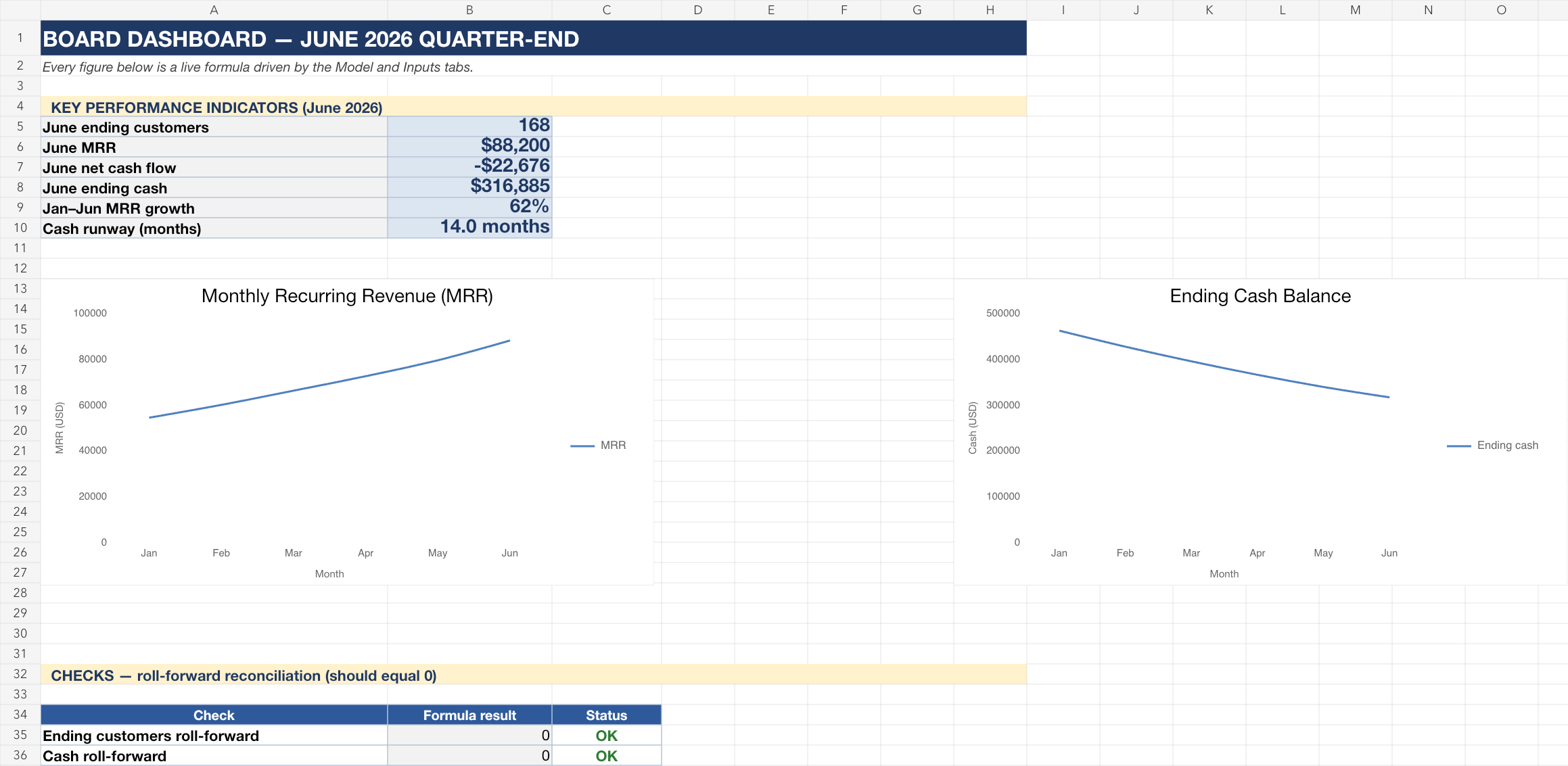
We corrected the references and reran a formula-error scan. The reviewed model reports 168 June customers, $88,200 in June MRR, $316,885 in ending cash, and zero for both roll-forward checks. The chart legends now name the KPI instead of saying “Series 1.”
Download the reviewed workbook Download the exact prompt and data
Review the plan like a skeptical reader
Check that the story and model agree
If the marketing section promises enterprise sales, the model needs a long sales cycle and the staff to support it. If the operations section requires inventory, the cash flow must fund it before sales. If the plan says the offer is premium, the price and customer segment must support that claim. Search the document for every number and reconcile repeated figures.
Ask the right professional before submission
Use an accountant for financial statements, taxes, and accounting assumptions. Use a lawyer for ownership, contracts, licenses, and regulated claims. Ask the lender or grant program about its own requirements. An investor-facing startup may need a fundraising narrative and cap table that a general business plan does not cover.
Keep an editable plan and update it with evidence
Separate the model, document, and final PDF
Keep financial calculations in a spreadsheet or dedicated planning model. Keep the narrative in an editable DOCX. Export a PDF only after review. This separation makes errors visible and lets you change an assumption without hunting through paragraphs, tables, and charts by hand.
OpenCraft can help you research, draft, chart, and produce editable artifacts without moving the work across several disconnected chats. See the AI report generator workflow for a deeper review process, or browse the resources and use cases for related work.
Treat the plan as a versioned decision record
Update the plan when actual results change an assumption. Record the date, evidence, author, and reason for each material revision. Replace forecasts with actuals as they arrive. A shorter plan that exposes what changed is more useful than a perfect-looking PDF that no longer describes the business.
Sources
- Write your business plan U.S. Small Business Administration
- Calculate your startup costs U.S. Small Business Administration
- Artificial Intelligence Risk Management Framework: Generative Artificial Intelligence Profile National Institute of Standards and Technology
Frequently asked questions
What is an AI business plan generator?
It is software that turns your business details, research, and assumptions into a structured plan. It can draft the narrative and format tables or charts. It cannot independently validate demand, costs, legal requirements, or financial projections.
Can AI write a complete business plan?
AI can write every standard section, but completeness is not the same as accuracy. A useful plan needs verified market evidence, named competitors, operating details, and a financial model built from assumptions you can explain.
Is an AI-generated business plan good enough for a bank loan?
Treat it as a draft. A lender may expect consistent projections, a specific funding request, repayment capacity, owner information, and supporting documents. Have an accountant, lender, or SBA resource partner review the final package for your situation.
What information do I need for an AI business plan generator?
Bring your customer definition, problem, offer, pricing, sales evidence, competitors, marketing channels, operating process, startup costs, monthly costs, funding need, and forecast assumptions. Mark estimates as estimates.
Can AI create financial projections for a business plan?
It can calculate projections from stated assumptions. It should not invent the assumptions. Review sales volume, price, payment timing, gross margin, staffing, taxes, capital spending, debt terms, and cash balances in a spreadsheet or financial model.
Can I edit and download an AI-generated business plan?
Yes, if the tool produces an editable format such as DOCX. Keep the editable source, review it, then export the approved version to PDF. Keep the financial model separate so you can update assumptions without rewriting figures by hand.